

As we all know, these days, establishing a startup with a sound environment and all the amenities is easy, but when it comes to handling it consistently, it won’t go in the right direction. In fact, according to studies, almost 90% of startups fail. It means only 1 out of 10 startups survives. And this failure rate is similar across all industries.
And, in order to make things right for startups, founders must find smart, cost-effective solutions that allow them to operate efficiently without draining their limited resources. In this scenario, one such solution that came out as an incredible choice is the concept of virtual offices. In fact, co-working spaces emerged as a strategic solution, helping brands to reduce burdensome overhead like expensive rents and capital expenditures (CapEx), while boosting productivity.
So, without further ado, let’s delve into the key points on how a virtual office can help startups save costs. But before that, let’s look at the clear picture of what Virtual Spaces are all about.
What is Virtual Office and How Is It Beneficial For Startups
As the name suggests, a virtual office offers businesses with a professional business address, mail & courier handling services, and access to conference rooms or co-working spaces—all without the need for an actual office. It combines the convenience of remote work with the legitimacy of an established corporate presence.
Major Cost Savings Areas with Virtual Offices
Nowadays, there is a lot to be said about how a perfect virtual office can help you save money, but what we have said so far does not cut the dilemma of how it can help you save money when compared to having a physical office.
So, let’s delve into it right away:
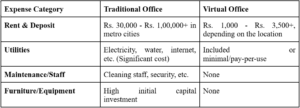
Lower Overheads and Rent Costs: Paying high rental prices for office space has become a significant challenge for companies, large and small, particularly for all businesses situated in prime locations in metropolitan areas. According to an Anarock report, average rents for office space range from INR 86 sft per month and increase 5% on an annual basis. As such, a virtual office is the most economical option available to business owners and freelancers since it can significantly reduce overhead (and therefore operating costs) by as much as 75% and allow for greater allocation of budget towards investing in other important areas.
Cutting Utility and Maintenance Expenses: Unlike traditional offices, virtual offices eliminate monthly costs like electricity, water, cleaning, and office furniture maintenance. This decreases fixed recurring expenses and reduces the financial burden on early-stage startups. They also help you reduce staffing costs by automating call handling and mail management. Additionally, they help employees save on travel, utilities, and daily commuting expenses, making remote teams more cost-effective.
Access to Flexible Workspace Solutions: Virtual offices usually provide immediate use of coworking spaces and meeting rooms on an as-needed basis, allowing new companies to save money on lease payments for office spaces that would otherwise go unused and streamline operational expenses. Besides providing workspace, many virtual office companies also provide recreation space, such as lounge areas and gaming rooms, to assist employees in achieving a healthy work-life balance and encourage employee wellness and creativity.
Scalability and Pay-as-You-Grow Models: Startups can choose virtual office packages that scale with their growth, allowing them to pay only for the services they use. This flexibility helps manage cash flow effectively and prevents costly long-term commitments.
Cost Comparison: Virtual vs. Traditional Office
The primary savings come from eliminating major expenses associated with a physical space, such as high rent, maintenance, and utility bills.
Additional Advantages Beyond Cost Savings
- Professional Business Image
- Increased Productivity and Work-Life Balance
- Attracting a Global Talent Pool
- Environmentally Friendly Practices
Why Startups Are Embracing Virtual Offices
The fact that there is a high rate of failure and considerable amounts of competition that start-ups are exposed to makes it prudent for start-ups to look to virtual offices as a strategic way to minimize expenses related to overhead costs without sacrificing the reputation of being a professional organization or scaling down operational efficiencies.
By using the savings from the rent and utilities to provide additional funding to the start-ups’ core business functions, such as marketing, product development, and workforce (employment) opportunities, the start-ups will be more successful in surviving and/or growing.
In addition, the company will have the flexibility and agility offered by virtual offices to change and adjust to the shifting marketplace needs as well as the ability to grow or contract as necessary.
In a nutshell, virtual offices can reduce overall costs associated with office materials or services, promote scalability of the start-up, enhance the brand image of the start-up, and provide the flexibility for a start-up to allocate resources prudently to enable success within an environment of intense competition.